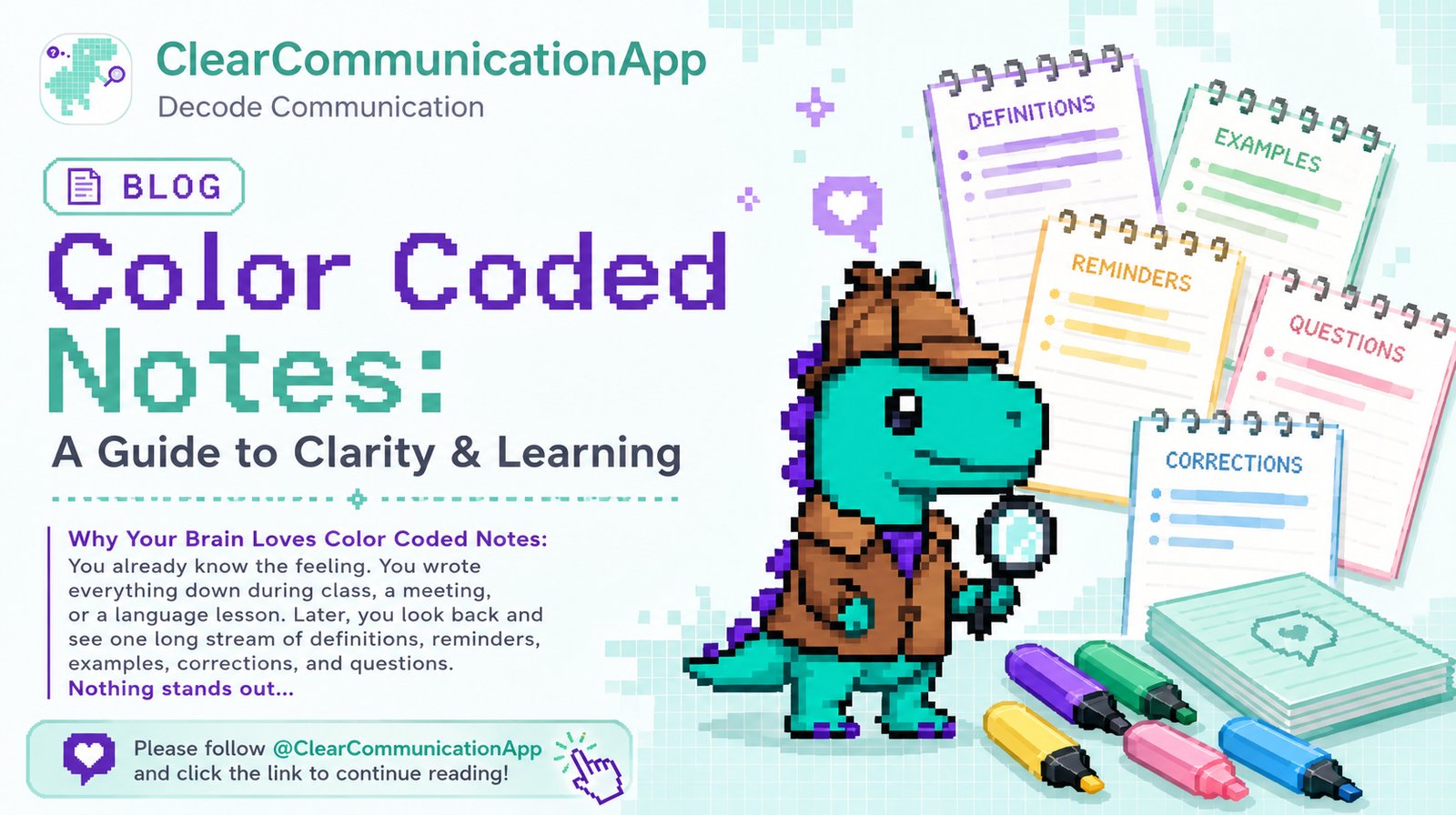
Color Coded Notes: A Guide to Clarity & Learning
Your notebook might look busy, but still feel useless. A page can be full of words and yet give you nothing back when you need to study, explain something clearly, or remember the right phrase in the right moment. That’s especially frustrating if you’re juggling English and Spanish, sorting through medical terms, or trying to build a system that works with your brain instead of against it.
Color coded notes can help because they turn a flat wall of information into something you can scan, sort, and trust. They don’t need to be artistic—they need to be clear.
Why Your Brain Loves Color Coded Notes
You wrote everything down during class, a meeting, or a language lesson. Later, you look back and see one long stream of definitions, reminders, examples, corrections, and questions. Nothing stands out. Color coded notes give your brain a shortcut: blue might mean “definition,” yellow “ask for help,” green “safe phrase I can use in conversation.”
A 2022 study found that 55% of students preferred color-coding for memory retention, with experimental groups reporting effectiveness rates as high as 66%. The reason: learners don’t struggle with effort—they struggle with retrieval. Color creates anchors.
Practical rule: If you need to reread a page from top to bottom just to find one idea, your notes are asking too much from your working memory.
Designing Your Personal Color-Coding System
Build the logic first. Pick colors second. Ask yourself what kinds of information keep appearing in your notes: key ideas, definitions, questions, examples, action items. For communication-focused notes: plain-language versions, medical vocabulary, tone cues, cultural context.
Keep the palette small. Choose four or five colors, give each color one job, leave some text plain, and review after a week. If every line is highlighted, none of the lines are highlighted.
A Sample Legend
- Blue: definition or direct meaning
- Green: useful phrase I can say out loud
- Yellow: question or confusion
- Red: common mistake or caution
- Purple: example or context clue
A Color-Coding Template for English and Spanish Learners
| ColorCategoryExample Usage | ||
| Green | New vocabulary | “appointment,” “receta,” “refund” |
| Blue | Grammar and structure | verb patterns, sentence frames |
| Yellow | Idioms and regional phrases | “hang in there,” “qué padre” |
| Red | Common mistakes | false cognates, awkward direct translations |
| Purple | Context and tone | formal request, family language, customer service |
Adapting Your System for Neurodivergence and Accessibility
Don’t rely on color alone. Pair each color with a second signal: blue + box for definitions, yellow + question mark for confusion, red + exclamation for warnings, green + underline for practice phrases, purple + star for tone nuance. This helps when color is unclear (color-blind users, photocopies, dim screens) and improves scanning even when color is visible.
Reduce overload: use softer shades, keep page layout predictable, reserve one strong color for urgent information, separate capture from cleanup (rough notes first, code them later), and make one-page templates for repeat situations like appointments or travel.
Integrating with ClearCommunicationApp
A color system becomes more useful when it connects to something you already use consistently. Pair your personal color legend with the phrase library: find a phrase, write it in your notes, apply your color legend, add one personal example, then review by category.
Color coded notes can also help you notice progress patterns—green for “I can say this naturally,” yellow for “I recognize it but need practice,” red for “I freeze or avoid it.” That coding shows where communication is still breaking down.
If you want a simple way to practice clearer everyday language in English and Spanish, ClearCommunicationApp supports that routine with a large phrase library and progress tools that fit well with a personalized note system.
Related Articles
Was this helpful?
One new phrase per week
Clear, practical tools for bridging communication gaps. No spam, unsubscribe anytime.
Share this article
