What a Social Skills Coach Does (And How to Find One)
What a Social Skills Coach Does (And How to Find One)
You reread a text message three times, and it still feels unclear. Was that reply joking, annoyed, or just brief? Later, at work or school, someone starts casual small talk and your mind goes blank. You know what you want to say. You just can’t seem to say it in a way that lands.
That experience is common. It’s common for autistic people, ADHDers, anxious adults, bilingual speakers, international students, and people who didn’t get much direct teaching about conversation. It’s also common for people who understand language well in one setting, then feel lost when slang, tone, sarcasm, regional phrases, or medical jargon suddenly enter the picture.
A social skills coach helps make those hidden rules visible. Not by judging you, and not by asking you to become someone else. A good coach teaches communication the way a patient teacher teaches any other skill: clearly, concretely, and with practice.
Feeling Awkward in Conversations You Are Not Alone
A lot of people think social ease is something you either have or you don’t. That idea causes harm. It makes people blame themselves for missing cues that were never explained in the first place.
The moment many people recognize
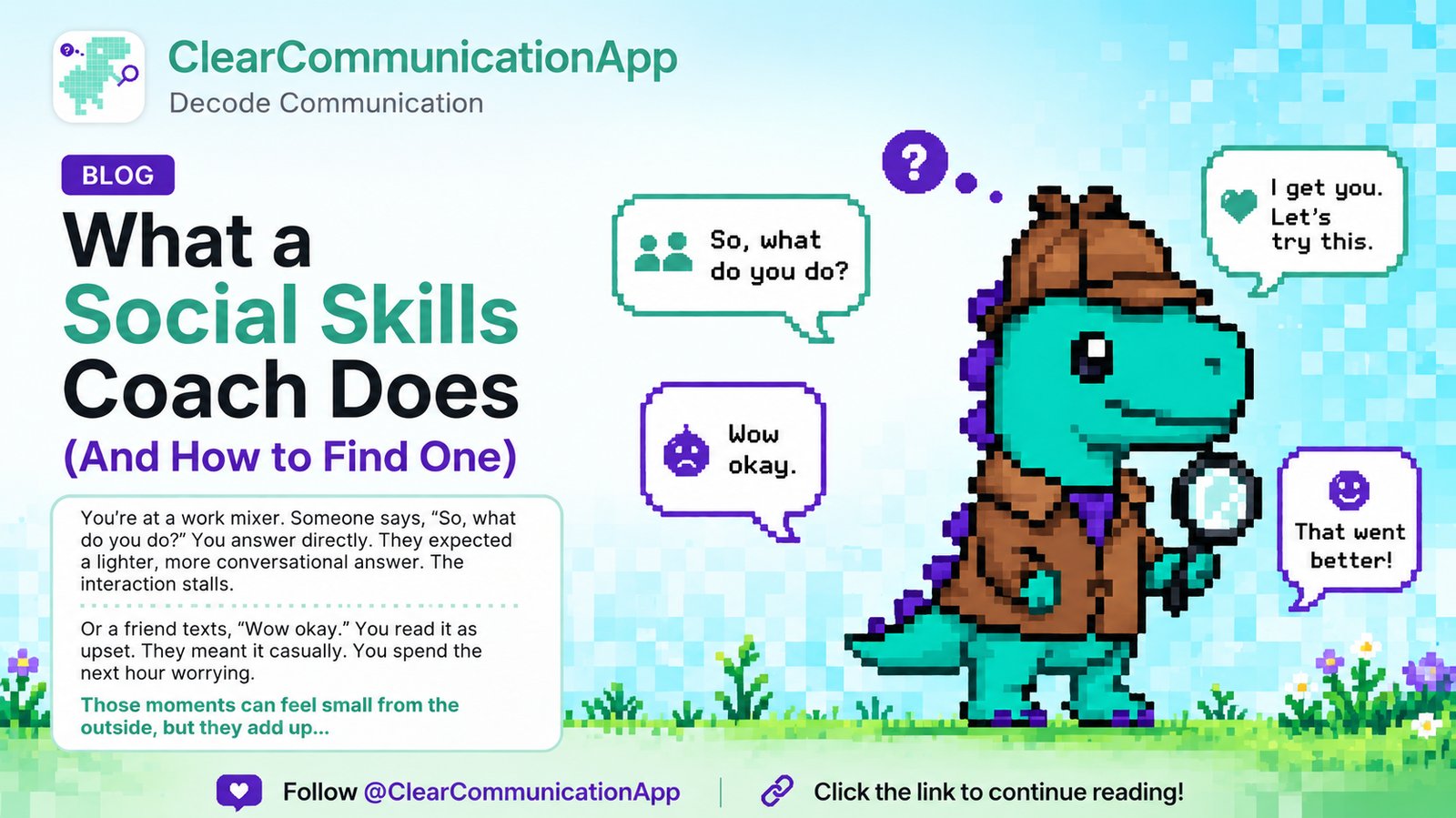
You’re at a work mixer. Someone says, “So, what do you do?” You answer directly. They expected a lighter, more conversational answer. The interaction stalls.
Or a friend texts, “Wow okay.” You read it as upset. They meant it casually. You spend the next hour worrying.
Those moments can feel small from the outside, but they add up. After enough of them, people start avoiding calls, group chats, meetings, dates, or family events. They stop trusting themselves.
Practical rule: Social confusion usually doesn’t mean you’re bad at communication. It often means nobody ever translated the unwritten rules into clear steps.
Why coaching is a real option
Social coaching isn’t a fringe idea. The broader coaching field generated $5.34 billion in 2025, and 99% of people who hire a coach report being satisfied or very satisfied. In that same data, 73% of clients report improvements in relationships and communication skills.
That matters because many people hesitate to seek support. They worry it sounds frivolous, or they assume they should “just figure it out.” But communication affects almost everything: work, school, friendship, dating, travel, customer service, family stress, and self-confidence.
What makes this especially relevant now
Digital communication has made some things easier and others harder. You can pause before answering, but you also lose facial expression, pacing, and tone. A short message can sound rude when it isn’t. Slang changes quickly. Different generations use the same phrase in different ways.
For bilingual speakers, the challenge can double. You may know the dictionary meaning of a phrase and still miss the social meaning. “We should get coffee sometime” might be a real invitation in one context and polite softness in another.
If you’ve felt behind, you’re not the only one. Many adults are trying on their own to learn skills that nobody taught directly. That’s one reason educational resources like the Clear Communication blog matter. They help turn vague social advice into something practical.
What a Social Skills Coach Really Does
A social skills coach is a lot like a personal trainer for communication. A trainer doesn’t just say, “Get stronger.” They watch your form, break movement into parts, and give you exercises you can repeat. A coach does that with conversations, boundaries, listening, tone, and body language.
A coach teaches patterns, not scripts alone
Some people assume social coaching is just memorizing lines. It isn’t. Scripts can help, especially at first, but the essential work is learning patterns.
A coach may help you notice things like:
- Turn-taking: when to speak, pause, or invite the other person in
- Repairing moments: what to say when a joke falls flat or you interrupt
- Reading context: when formal language fits, and when it sounds stiff
- Clarifying unclear words: especially slang, idioms, indirect requests, and figurative language
- Adjusting audience: how you speak to a professor, cousin, customer, doctor, or friend
That’s why coaching feels different from random advice from friends. Friends often say things like “just be confident” or “read the room.” A coach slows the room down and explains what “reading” means.
What a session often includes
A coach usually starts by asking where communication breaks down most often. The answer might be “I talk too much when I’m nervous,” “I can’t start conversations,” or “I understand the words, but not the social intention.”
From there, coaching often includes a few core moves:
- Spot the friction point. Not “be better socially.” Something specific, like missing when someone wants to end a conversation.
- Name the skill underneath. That might be topic shifting, noticing facial changes, or asking follow-up questions.
- Practice in a low-pressure setting. You rehearse before using the skill in daily life.
- Reflect without shame. The point is not “you failed.” The point is “what did you notice, and what can we tweak?”
Good coaching replaces vague self-criticism with observable skills.
What a coach is not
A social skills coach isn’t there to erase your personality. They also shouldn’t force eye contact, demand masking, or treat difference as defect. For neurodivergent people especially, respectful coaching should support communication and self-advocacy, not push constant performance.
A coach also isn’t only for crisis situations. Plenty of people seek coaching because they want clearer conversations, smoother workplace interactions, or better ways to explain themselves across language and cultural gaps.
Who Can Benefit from Social Skills Coaching
The short answer is simple. Many kinds of people can benefit. The better answer is more useful: different groups benefit for different reasons.
Neurodivergent people who want clearer rules
Autistic and ADHD individuals often hear advice that’s far too vague. “Be more natural.” “Try to connect better.” “You came off intense.” None of that tells you what to do next.
A coach can translate broad feedback into teachable parts. For example, if meetings feel confusing, the issue may not be “poor people skills.” It may be difficulty with interruption timing, indirect requests, or reading when a topic has shifted. Once those pieces are named, they become practiceable.
This is especially helpful when a person communicates well in one format but not another. Someone may write beautifully, yet freeze during live conversation. Another person may speak fluently but miss hidden meanings like soft disagreement or polite deflection.
English and Spanish learners who need social meaning, not just vocabulary
Language learning often focuses on grammar first. Real life rarely does. Real life gives you things like, “I’m good,” “No worries,” “Ahorita,” “We’ll see,” or “Let’s circle back.” The words are simple. The meaning depends on context, culture, relationship, and tone.
A social skills coach can help bilingual learners with:
- Idioms and soft phrases: understanding what people really mean
- Register shifts: knowing when casual speech sounds warm versus too casual
- Repair language: phrases like “Can you say that another way?” or “I want to make sure I understood”
- Accent confidence: practicing clarity without shame
- Medical and professional language: turning dense terms into plain explanations
That last point matters a lot. Medical language can overwhelm anyone. Phrases like “benign,” “chronic,” “acute,” or “follow up as needed” can feel simple to professionals and confusing to patients. Coaching can help people ask better questions and restate information in plain language.
People navigating generational and regional language gaps
A phrase that sounds normal in one age group can sound cold, funny, or rude in another. “Bet,” “I’m dead,” “sure,” “bless your heart,” and “you’re fine” all shift meaning depending on age, location, and context.
That’s one reason social skills support is becoming more relevant. Between 2003 and 2022, face-to-face socializing among teenagers dropped by over 45%, and 53% of high schools reported a significant focus on social-emotional learning.
Less in-person practice means fewer chances to learn social nuance through repetition. People then carry that uncertainty into college, work, dating, and adulthood.
If you’ve ever thought, “I know the words, but I don’t know the code,” you’re describing a coaching problem, not a character flaw.
Professionals who want steadier communication
Customer support staff, managers, educators, healthcare workers, and service professionals often need social precision. They must sound clear, calm, and kind under pressure. Coaching can help them soften conflict, explain processes more clearly, and respond without sounding scripted.
It can also help people who are technically skilled but socially drained. Plenty of capable workers need help with speaking up in meetings, joining group conversations, or setting boundaries without sounding harsh.
Inside a Coaching Session Methods and Frameworks
Many people feel less anxious once they know what happens in a coaching session. It’s usually far more structured than people expect.
A structured model that makes skills teachable
One useful framework includes five parts: assessment, motivation, skill acquisition, generalization, and peer sensitivity. For neurodivergent individuals, this model can be especially effective because it turns social learning into a sequence rather than a mystery. In controlled groups, peer inclusion work in this model has been shown to decrease bullying by 20% to 30%.
Assessment
The coach figures out where communication is already working and where it breaks down. This isn’t about listing flaws. It’s about finding patterns.
You might discuss questions like:
- Which situations feel hardest?
- Do texts feel easier than live conversation?
- Are misunderstandings more common with coworkers, relatives, or strangers?
- Do you struggle more with starting, sustaining, or ending conversations?
A good assessment also respects your goals. Some people want better friendships. Others want to handle appointments, interviews, or customer interactions.
Motivation
People learn faster when the reason is real. “Be more social” is weak motivation for most adults. “I want to stop panicking before meetings” is much stronger. “I want to understand Spanish-speaking relatives better” is clear and personal.
Motivation also matters for neurodivergent learners who’ve had painful experiences. If social practice has mostly meant correction, embarrassment, or masking, the coach needs to rebuild safety first.
A grounding reminder: Progress starts when the goal belongs to you, not when you perform for someone else.
Skill acquisition
This is the teaching part. The coach introduces a skill in a concrete way and often models it.
That might include:
- how to ask a follow-up question
- how to show listening without forcing unnatural body language
- how to say “no” politely
- how to explain confusion without apologizing for existing
- how to unpack indirect language like “whenever you get a chance”
A coach may use role-play, written examples, visual supports, or repeated practice. For language learners, this stage often includes comparing literal translation with social meaning. For example, a direct sentence may be grammatically correct but feel too blunt in context.
Generalization and peer sensitivity
A skill isn’t useful if it only works in a coaching session. Generalization means trying it in actual life. You might practice greeting a cashier, asking one extra question in class, or sending a clearer message to a friend.
Peer sensitivity matters too. Social success isn’t only the learner’s job. Other people also need to be inclusive, patient, and willing to communicate more clearly. That’s especially important for autistic people and multilingual speakers, who are often expected to do all the adapting themselves.
Putting Skills into Practice Sample Exercises and Goals
Social growth becomes easier when goals are concrete. “Be less awkward” is not a usable goal. “Start one short conversation before class three times this week” is.
A simple example from daily life
Take a college student who can answer questions well but rarely starts conversations. A coach might begin with one tiny target: greet one classmate and ask one follow-up question.
The first practice round might sound like this:
- “Hey, did you understand the assignment?”
- “How did you approach it?”
- “That makes sense. I got stuck on the second part.”
This may look basic, but basic is often what works. Small wins build momentum.
Behavioral coaching methods like role-playing and active listening practice can improve success in initiating conversations by 40% to 60% after 8 to 12 sessions. Targeted social instruction has also been linked to an 11 percentile point gain in academic performance.
Exercises a coach might assign
Not every exercise fits every person. A good coach matches the task to your stress level, language background, and real environment.
Here are common examples:
- Five-minute small talk practice. Pick one low-stakes setting, such as before class or during a work break. Stay in the conversation briefly, then leave politely.
- Paraphrasing drill. After someone explains something, respond with “So what I’m hearing is...” This helps with listening, memory, and repair.
- Tone check journaling. Write one phrase that confused you this week. Note the exact words, the likely intention, and what clues helped.
- Boundary sentence rehearsal. Practice lines like “I can’t take that on right now” or “I need more time to think.”
A phrase library can also help with this kind of practice. For example, the Clear Communication phrase library can support repeated review of expressions in English and Spanish, especially when a learner is trying to understand everyday wording rather than textbook wording.
A better way to set goals
A useful social goal is usually:
| Goal qualityWhat it sounds like | |
| Specific | “Ask one follow-up question” |
| Measurable | “Do it three times this week” |
| Achievable | “In familiar settings first” |
| Relevant | “Because I want to make friends in class” |
| Time-bound | “Track it for two weeks” |
That kind of goal protects people from all-or-nothing thinking. If you’re neurodivergent or speaking in a second language, that matters. Social learning often stalls when the target is too fuzzy.
Examples that fit different learners
- Someone learning English may practice how to soften disagreement: “I see your point, but I read it differently.”
- Someone learning Spanish may practice repair phrases: “¿Me lo puedes decir de otra manera?”
- Someone who struggles with medical communication may rehearse: “Can you explain that in simpler words?” or “What does that term mean in everyday language?”
Those are social skills too. They’re not small. They’re life skills.
How ClearCommunicationApp Supports Your Journey
Daily communication practice usually falls apart for one reason. People don’t have a clear way to keep using the skill between coaching sessions, classes, or moments of motivation.
Why practice tools matter
Long-term tracking is a real challenge in social skills work. Some studies have found 70% of participants relapsed within 6 months when real-world application wasn’t tracked, and gamified apps can improve adherence by 40%.
That doesn’t mean apps replace a coach. It means practice and feedback need a home in everyday life.
Where an app can help most
For neurodivergent users, one of the hardest parts of communication is inconsistency. You might do well in one conversation and feel lost in the next. A digital tool helps by making language visible and repeatable.
For English and Spanish learners, it can also bridge the gap between literal translation and socially appropriate phrasing. That matters with:
- Idioms: phrases that don’t make sense word for word
- Generational language: expressions that change across age groups
- Regional wording: one phrase in Texas, another in Madrid, another in Mexico City
- Professional and medical language: terms that need simpler restatement
A tool built around phrase practice can reduce the pressure of real-time performance. You review, compare, repeat, and return to it later.
Why ClearCommunicationApp fits this kind of learning
ClearCommunicationApp is useful because it focuses on real-world clarity rather than abstract theory. Its web-based platform includes 3,400+ phrases across English and Spanish, plus features like Library, Stats, Ranks, Friends, and Profile. That combination is helpful for people who need both explanation and repetition.
The value is practical:
- Library supports phrase-by-phrase learning for idioms, context, and translation
- Stats helps users see which expressions they’ve practiced and where confusion remains
- Ranks adds light structure for consistency
- Friends can make practice feel less isolating
- Profile gives users a place to track progress over time
For someone working on social confidence, that means less guessing. For a bilingual learner, it means more context. For a person trying to decode medical or workplace wording, it means plain-language support in a format they can revisit.
A practice routine can be simple. Review a few phrases, rehearse one likely scenario, and use a time box so it doesn’t become overwhelming. Tools like the ClearCommunicationApp timer can help turn that into a repeatable habit.
Choosing Your Coach and What to Expect
Finding the right social skills coach isn’t only about credentials. Fit matters. So does the coach’s attitude toward difference, language, and real-life goals.
Questions worth asking
You don’t need to interview a coach like a detective, but a few direct questions can save time.
Consider asking:
- Experience: Have you worked with autistic, ADHD, or bilingual clients?
- Approach: How do you teach social skills in concrete terms?
- Goals: How do you help clients choose goals that fit real life?
- Feedback style: How do you give correction without shaming?
- Progress: How do you measure improvement?
- Respect for identity: How do you support communication without forcing masking?
Pay attention to the answers. If a coach talks only about “normal behavior” or pushes rigid rules without context, that’s a concern. Good coaching should improve understanding and agency.
Social Skills Coach vs. Other Professionals
| ProfessionalPrimary FocusTypical MethodsBest For | |||
| Social skills coach | Everyday communication and interaction skills | Role-play, feedback, practice tasks, goal setting | People who want clearer conversations, better boundaries, and more confidence in real situations |
| Therapist | Emotional health, patterns, distress, trauma, anxiety, coping | Talk therapy, structured therapeutic methods, reflection | People dealing with anxiety, depression, trauma, or emotional barriers linked to communication |
| Psychologist | Assessment, diagnosis, treatment planning, therapy in some settings | Evaluation, therapy, behavior-based strategies | People who need diagnostic clarity, deeper clinical support, or formal evaluation |
| Life coach | Broad personal or professional goals | Goal planning, accountability, reflection | People working on direction, motivation, habits, or career transitions |
Sometimes people work with more than one professional. A person might see a therapist for anxiety and a social skills coach for practical conversation practice. Those roles can complement each other.
What progress usually feels like
Progress is often uneven. One week you may feel strong. The next, a stressful family event or a language-heavy workday may throw you off. That doesn’t erase growth.
Look for signs like these:
- recovering faster after an awkward moment
- asking for clarification sooner
- noticing tone more accurately
- ending conversations more smoothly
- feeling less exhausted after routine interactions
A good coach won’t promise a new personality. They’ll help you build usable skills that make daily life easier.
Frequently Asked Questions About Social Skills Coaching
Is social skills coaching only for children
No. Adults use social coaching for work, dating, friendships, family communication, travel, interviews, and self-advocacy. Many adults seek help because they were never taught these skills directly.
How long does it take to notice change
That depends on your goals, stress level, and how often you practice. Some people notice small changes quickly, such as starting conversations more comfortably or using clearer repair phrases. Bigger changes usually come from repetition and real-life use.
Is social skills coaching the same as therapy
No. Therapy focuses more on emotional health, mental health conditions, and deeper psychological patterns. Social coaching focuses more on teachable communication behaviors and real-world practice.
Can a social skills coach help with bilingual communication
Yes. This can be especially useful if you know vocabulary but struggle with idioms, tone, slang, regional wording, or professional phrases in English or Spanish.
What if I’m neurodivergent and hate being “trained” to act normal
That concern makes sense. Respectful coaching should help you communicate more clearly and advocate for yourself. It shouldn’t erase your identity or pressure you into constant masking.
Can coaching help with medical communication too
Yes. Many people need help understanding medical language, asking follow-up questions, and restating information in simpler words. That’s a valid communication goal.
If you want a supportive way to practice everyday language between coaching sessions, classes, or work interactions, ClearCommunicationApp gives you a practical place to start. Its English and Spanish phrase library, progress tracking, and simple practice tools can help you build clearer communication one real-world phrase at a time.
Was this helpful?
One new phrase per week
Clear, practical tools for bridging communication gaps. No spam, unsubscribe anytime.
Share this article